
Electronic Invoices in Slovakia from 2027: Key Points About the New Rules
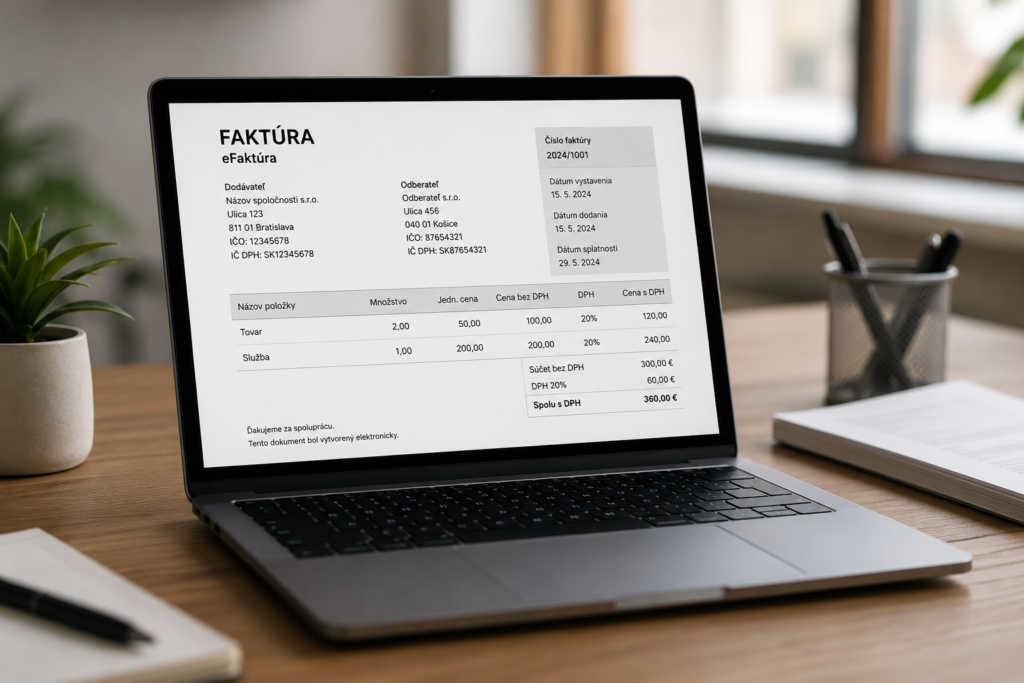
From 1 January 2027, mandatory electronic invoicing (e-faktúra) will be introduced in Slovakia for all VAT payers. This is one of the most significant changes in tax administration in recent years, effectively converting all internal business document flow into a digital format. Traditional invoices sent as PDFs via email will no longer be considered valid tax documents.
XML instead of PDF
It is important to understand that an electronic invoice in the new sense does not mean a regular electronic file. It refers to a strictly structured document in XML format, compliant with the European standard EN 16931. In practice, this means using formats like Peppol BIS 3 or UBL 2.1, which are designed not for human reading but for automatic processing by software systems.
The main difference in the new system is that the invoice becomes not a “document for viewing” but a “set of data”. If a PDF file needs to be manually entered into accounting or processed through an OCR system, an XML invoice is immediately read by the system, automatically recorded, checked, and if necessary, sent to the tax authority without human intervention.
Peppol
The electronic invoicing system in Slovakia will operate through the standardised European infrastructure Peppol. This is an international network for exchanging electronic documents, already used in many EU countries, including Italy, France, Germany, and Poland. Peppol can be seen as a unified digital postal system through which companies exchange documents in the same format regardless of the software used.
Within this system, the so-called “digital postman” — a certified operator (Access Point) — plays a key role, providing the technical processing of documents. It converts the invoice into the required format, sends it through the Peppol network to the counterparty, and simultaneously transmits the necessary data to the tax system. Thus, the state receives information about the transaction almost in real time.
The step-by-step process will look like this. An entrepreneur creates an invoice in their program, which must support the creation of an electronic invoice according to the EN 16931 standard and export it in Peppol BIS 3 (XML) format. Examples of such software include SuperFaktúra, iDoklad, Pohoda, and FLOWii.
After that, the program will send the invoice data to a certified operator (Access Point) connected to the Peppol network. From there, the electronic invoice will reach the recipient and the tax authorities.
From a technical standpoint, the entrepreneur will not have to manually work with XML or understand the document structure. All complexity will be hidden within the software. Businesses will continue to issue invoices as before — through invoicing software, entering standard data about the client, service, amount, and payment terms. However, the system will automatically handle all the technical aspects: generating the electronic invoice, checking its accuracy, and sending it through established channels.
Who will be affected by the new rules?
The new electronic invoicing rules will affect almost all businesses operating within the country. Primarily, the obligation will apply to all VAT payers. They will be required to issue electronic invoices for internal B2B transactions, i.e., transactions between companies, as well as when interacting with government institutions in a B2G format.
Importantly, the obligation to accept electronic invoices will be even broader. It extends not only to VAT payers but to all economic entities in the country. This means that individual entrepreneurs, small companies, non-profit organisations, associations, and any other legal entities must be able to process electronic invoices, even if they are not required to issue them themselves. This effectively makes the system a universal standard for all business transactions.
The logic of the system is that the invoice is no longer a static file sent via email. Instead, it becomes part of a digital data flow. After being created in accounting software, the document is automatically converted into XML format and transmitted through Peppol infrastructure or government exchange channels. During delivery, the data can simultaneously reach both the recipient and the tax authority, ensuring almost continuous transaction monitoring by the state.
Peppol in this system acts as a single European exchange network. It ensures compatibility between different programs and countries, allowing companies to send and receive invoices regardless of the software they use. A certified intermediary — the same Access Point or “digital postman” — is used to connect to Peppol. It is responsible for correctly formatting the document and securely transmitting it to government systems.
Transition period
An important feature of the new model is mandatory automatic reporting. Data from electronic invoices will be transmitted to the tax authority in a mode close to real time. This significantly reduces the potential for errors and simultaneously strengthens control over VAT turnover.
Experience from other countries shows that transitioning to such a system requires time and adaptation. In the first months after implementation, technical failures, data processing delays, and the urgent need to replace software may occur. This is especially true for small businesses that previously used simple tools like Word, Excel, or basic PDF templates.
Therefore, the transition period is considered a critically important stage. Companies that implement compatible invoicing systems in advance will gain a significant advantage, as they will be able to avoid disruptions in operations and issues with tax reporting.
What will happen next?
From 1 July 2030, the electronic invoicing system in Slovakia will be expanded. The obligation to use electronic invoices will extend not only to domestic operations but also to cross-border transactions within the European Union. This means that electronic invoicing will become a single standard for most B2B operations in the EU.
Simultaneously, the tax reporting system will be changed. It is planned to gradually reduce or completely abolish certain VAT reporting forms, including control and summary reports. Instead, tax authorities will receive data directly from electronic invoices, which are automatically transmitted to the system.
Additionally, the link between the invoice and the right to a tax deduction will be strengthened. In the future, VAT deduction will only be possible with a correctly formatted electronic invoice in the established format. This makes it not just a document but a mandatory condition for tax accounting. Financial sanctions will be imposed for non-compliance with the requirements. Fines can reach up to 10,000 euros, especially for repeated violations or systematic non-compliance with the rules.
Experience from countries that have already implemented mandatory electronic invoicing shows a similar transition model. For example, in Italy, all invoices go through the state system SdI, which automatically checks the structure of XML documents and rejects incorrect files. Correcting errors requires reissuing the document through corrective procedures. In Hungary, the NAV online reporting system operates, where each invoice is transmitted to the tax authority in real time. In case of discrepancies, data must be corrected by reissuing the invoice. In both cases, the transition led companies to almost completely abandon manual invoicing and switch to specialised invoicing systems that automatically generate XML and send data to government platforms.