
Attention Test for Business: How to Avoid Fines Due to a Cash Receipt
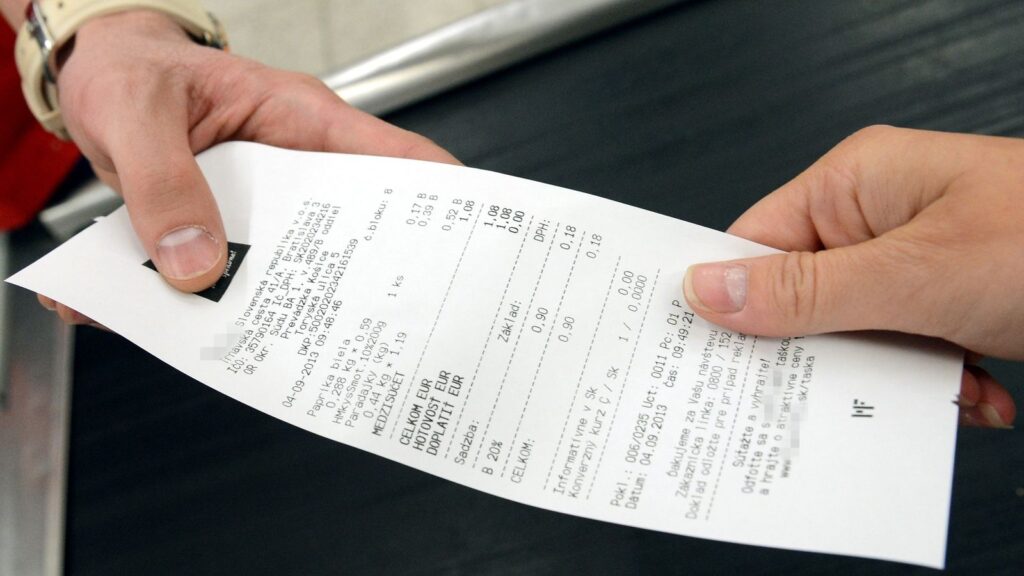
In May 2026, one of the most discussed topics in Slovakia became the so-called “langoš case” (kauza langoš) — a situation where an entrepreneur from the Trnava region was fined for the absence of diacritics on a cash receipt, meaning incorrect use of Slovak symbols.
Later, the fine was cancelled, but the story itself caused a noticeable stir and showed that many entrepreneurs are not fully familiar with the updated requirements for cash receipt formatting, which came into effect on 1 January 2026 as part of the e-Kasa system reform.
Rules are Getting Stricter
The Financial Administration of Slovakia has been tightening control over cash transactions in recent years, and the cash receipt is now seen not as a formality but as a strictly regulated tax document. This means that any deviations from the established requirements can be interpreted as a violation of the law, even if it concerns technical details of formatting.
According to the current law on revenue accounting, entrepreneurs using the e-Kasa system are obliged to issue a cash receipt to the customer immediately after payment registration. The receipt can be either printed or sent electronically, but only if the customer has previously agreed to the electronic form. The law explicitly prohibits issuing multiple originals of the same receipt, as well as any changes to an already formed document. Once printed or sent, the receipt is considered final and cannot be corrected.
The form of the electronic receipt is also separately regulated. If the customer chooses the electronic option, the seller is entitled to temporarily process their contact details, such as an email address, solely for the purpose of sending the document. After this, the receipt is sent electronically, and a printed version is not issued.
What Must Be Included in the Receipt?
A cash receipt generated through e-Kasa must strictly comply with the established list of mandatory data. The law requires that the document allows for the unambiguous identification of both the seller and the transaction itself, as well as containing complete tax information.
First and foremost, the receipt must include the seller’s details: their name, legal address, and place of business if it differs from the legal address. The tax identifier — DIČ — must be recorded, and if the entrepreneur is a VAT payer, then also the VAT identification number. This data allows for the unambiguous identification of the entity that made the sale.
Next, the receipt must include the document’s technical parameters: receipt number, transaction identifier, date, and exact time of its formation. An essential part is also the presence of a QR code and the seller’s verification code, which allow tax authorities and the customer to verify the document’s authenticity.
How to Correctly Write the Product Name?
A separate set of requirements concerns the essence of the sale itself. Each product or service must be described in such a way that it can be unambiguously identified. The law explicitly prohibits using overly general formulations or solely codes.
For example, the designation “dairy product” is considered insufficient, whereas “butter,” “cheese,” or “yogurt” are acceptable. Similarly, in the service sector, it is not enough to write “car repair” — clarification is needed, such as “brake pad replacement” or “body painting.” The purpose of this requirement is that the receipt can be used not only for tax accounting but also in possible complaints or inspections.
The requirement to use the Slovak language and correct diacritics is emphasised separately. All symbols must be displayed correctly, including special characters of the Slovak alphabet. This requirement became the subject of public discussion in connection with the kauza langoš, where the absence of diacritics was interpreted as a violation. Despite the subsequent cancellation of the fine, the case itself showed that even formal language errors can become grounds for claims from the financial administration.
Additional Information and Fines
The law also regulates cases of goods returns, complaints, and special operations, such as the sale of gift vouchers or working with deposit packaging. In such situations, the receipt must contain correct identifiers, allowing the operation to be linked to the original sale or recorded as a return.
Violations of cash receipt formatting requirements are considered administrative offences and can result in significant fines. Depending on the nature of the violation, sanctions range from small amounts to several thousand euros. For example, issuing a receipt that does not meet the established requirements or lacks mandatory data is subject to fines ranging from 150 to 6,500 euros, with increases for repeated violations.
More serious sanctions apply in cases of gross violations, such as using an incorrect cash system, altering an already issued receipt, or failing to issue it. In these cases, fines can range from 1,500 to 20,000 euros, and for repeated violations — be even higher. The Financial Administration separately emphasises that correcting an error during an inspection does not exempt from liability: the fact of the violation is recorded at the time of its detection, and correction may only affect the fine’s amount but not cancel it.